I’ve been meaning to write this blog for quite some time now, and in many ways, that feels fitting. Time, or more accurately, my relationship with it, has been at the centre of everything I’ve been working on lately, and perhaps also the reason I’ve been absent here.
Over the past few months, I’ve been immersed in a series of creative projects exploring memory, perception, relationships, and the often unnoticed ways we move through the world. Each piece has developed its own voice, but they are connected by a shared thread: a growing sense that time is not as fixed or linear as we often assume.
Alongside this, I have continued my academic work, developing papers and refining ideas grounded in my research. It is work I value deeply and find meaningful. However, I have also become increasingly aware of how easily time can be given over to tasks, commitments, and expectations, without a clear sense of ownership.
Much of my current writing, including my collection Lost in Time, considers time not simply as a measurable construct, but as a lived experience. The feeling of being slightly out of step. Of observing others move through structured routines with certainty, while one’s own sense of time feels more fluid, stretched, interrupted, or uneven.
This is not only a creative concern. It is also, I think, a professional one.
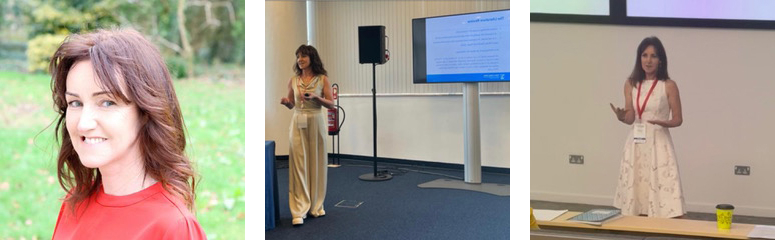
In educational contexts, time is often organised, segmented, and accounted for, by schedules, curricula, and outcomes. I spoke about this recently in a Slow Inclusion Seminar hosted by Marino Institute of Education https://www.mie.ie. Like myself, many educators in Ireland and internationally are increasingly aware that we live in a world that hurries us, and of how time, or the lack of it, impacts everyone. Yet the experience of time, for both educators and children, does not always align with structured schedules, curricular demands, and outcome-driven expectations. Moments of thinking, reflection, uncertainty, or dialogue do not fit neatly into fixed timeframes, and yet these are often the moments where meaningful learning occurs.
I have found myself reflecting on how often I say yes to work because it is valuable, necessary, or expected. And much of it is. However, this has led me to a quieter but persistent question: at what point do we need to pull back? At what point does time shift from something we actively use, to something that feels increasingly out of our control?
But I have started to pay closer attention to it.
Not by withdrawing from work or responsibility, but by becoming more aware of how time is experienced, not just managed. In both professional and personal contexts, this awareness feels increasingly important.
Perhaps the question is not simply how we organise time, but how we recognise and respond to the ways it is lived. It is a line of thinking I hope to revisit, as I continue writing and reflecting on time, practice, and real-world experiences.